
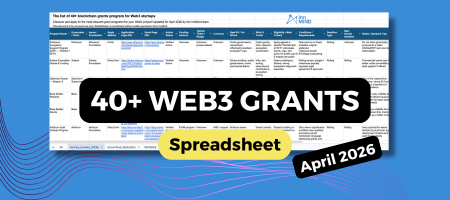
Updated in April 2026, this practical, founder-grade database of 40 active Web3 grant opportunities across major blockchain ecosystems, public goods programs, security support tracks, builder initiatives, and non-dilutive funding routes.
If you are fundraising in 2026, you already know the reality.
Investor capital is still out there, but getting attention got harder, slower, and much more selective. For many early-stage Web3 founders, grants are now one of the few real funding channels that can move before a round is closed.
The problem is not finding articles about grants or listings.
The problem is finding grants that are actually active, still have a working application path, fit your startup, and are worth your time.
That is exactly what this database is for.
This is not another stale “top Web3 grants” blog post written for pageviews.
It is a working database built for founders who want to move from research to application fast. And actually get funded.
Inside, you get the exact details that matter when you are deciding whether a grant is worth chasing:
- program name
- ecosystem / foundation
- official grant page
- direct application page or apply route
- active status
- funding amount where public
- typical ticket size or known range
- best fit by startup type
- what the program funds
- eligibility criteria
- key conditions and restrictions
- deadline type
- next known deadline where visible
- practical founder notes for outreach and applications

Why this is different from a typical “Top Web3 Grants” article
Most grant lists online are content.
This is workflow.
Free articles usually give you a few logos, a few vague summaries, and zero clarity on what to do next. They rarely tell you whether the program is still active, whether the apply link still works, whether it fits commercial startups, or whether you are about to waste two days on a grant that only funds open-source public goods.
This database is designed to answer the questions founders actually ask:
- Is this grant still active in 2026?
- Is there a real application link?
- Is this for infra, DeFi, consumer, gaming, AI x crypto, security, or public goods?
- Is it a real non-dilutive grant, a subsidy, a retroactive reward, or in-kind ecosystem support?
- Do I need open-source code, milestones, KYC, traction, audits, or technical readiness?
- Is this actually relevant for my startup stage?
That difference saves time. A lot of it.
And not just another 20 minutes. But days of messy research, dead links, governance forum hunting, and reading ecosystem pages that never tell you what you actually need to know.
What kinds of funding opportunities are covered
This database includes a broad mix of Web3 grant and grant-adjacent support programs, including:
- non-dilutive ecosystem grants
- builder grants
- developer grants
- public goods funding
- research and protocol support
- audit and security subsidy programs
- retroactive reward tracks
- ecosystem credits and infrastructure support where relevant
What kinds of Web3 startups is this for?
This database is especially useful for teams building in areas such as:
- infrastructure and developer tooling
- DeFi and onchain finance
- wallets, payments, and stablecoin tooling
- AI x crypto
- consumer and social apps
- gaming and mini-app ecosystems
- security and audits
- public goods and open-source software
- ZK and Layer 2 ecosystems
- Bitcoin-focused open-source work
- protocol research and deep technical products
Ecosystems covered
The database spans a wide slice of the current ecosystem, including programs connected to:
Ethereum, Solana, Optimism, Base, Arbitrum, Cosmos, Stellar, Tezos, Internet Computer, Hedera, Bitcoin, Starknet, Aptos, NEAR, Sui, Polygon, Avalanche, Monad, Mantle, Filecoin, Gnosis, Celo, Chainlink, Injective, Berachain, Polkadot, and TON.
Real examples inside the database
To give you a sense of what is included, the database covers active opportunities such as:
- Ethereum Ecosystem Support Program (ESP)
- Solana Foundation Grants & Funding
- Optimism Grants
- Arbitrum Audit Subsidy Program
- Stellar Community Fund
- OpenSats General Grant
- Starknet Seed Grants
- Sui DeFi Moonshots
- Avalanche Retro9000
- Chainlink BUILD Program
- TON Ecosystem Grants
Funding examples you can find inside:
Where the ecosystem publishes public numbers, the database captures funding signals such as:
- 1–5 ETH builder grants
- up to $25,000 seed-stage grants
- up to $50,000 open-source and infrastructure grants
- up to $150,000 ecosystem build awards
- up to $500,000 for selected high-conviction programs
- larger treasury-backed or seasonal pools where direct per-project allocations vary
Not every program discloses exact ticket size publicly. That is exactly why a cleaned database is useful: it helps you see quickly where funding is transparent and where it is not.
Why this matters in 2026
This market does not reward lazy fundraising.
Warm intros are harder to get.
Investor reply rates are worse.
Rounds take longer.
And many founders still ignore one of the few funding channels that can bring real capital without immediate dilution.
The winners are not the founders who “know grants exist.”
The winners are the founders who know:
- which grants are alive
- which ones actually fit
- which are worth the application effort
- and how to prioritize them before everyone else gets there
That is the job of this database.
What you actually get
When you buy this document, you get a clean working file that helps you:
- shortlist relevant grant opportunities faster
- save hours of ecosystem research
- compare programs by fit, not hype
- build a non-dilutive funding pipeline in parallel with investor outreach
- move from “maybe we should look into grants” to actual applications
This is not a generic educational PDF.
It is an operating document for founders who want live opportunities, direct apply routes, and execution value.
Who should buy this
This database is best for:
- early-stage Web3 founders actively fundraising
- startups looking for non-dilutive capital in 2026
- teams choosing which ecosystem to build on
- grant consultants and operators supporting multiple startup applications
- founders who are tired of wasting time on stale grant directories
Why it is worth €19
Because the alternative is not “free”.
The alternative is spending the next several days manually checking ecosystem websites, old grant articles, Discord posts, forum threads, and half-broken forms to figure out what is still alive.
This database compresses that work into one usable file.
You are not paying for words.
You are paying for speed, clarity, and a cleaner path to live capital.
Included in paid InnMind Membership
InnMind paid startup plans start from €49/mo and include access to premium fundraising resources, databases, templates, and downloadable materials, so this document also fits naturally into the broader resource stack for founders who want more than a single file.
Frequently Asked Questions (FAQ)
You get a structured database of 40 active Web3 grant opportunities in 2026. It includes grant names, ecosystems, official grant pages, application links or apply routes, active status, funding notes, eligibility criteria, deadlines, and practical founder tips.
The database is built specifically to avoid the usual “dead grant list” problem. It focuses on opportunities with visible grant pages and application paths that are relevant in the end of April 2026, rather than old ecosystem announcements or historic grant programs with no live route.
Yes. Wherever possible, the database includes a direct form, intake portal, GitHub application route, or official application page. If the apply route is portal-based or ecosystem-specific, that is made clear in the file.
Many of them are. Some are classic non-dilutive grants. Others are subsidies, retroactive rewards, in-kind support, or ecosystem credits. The file helps you quickly understand which is which before you invest time in applying.
No. The database includes both public goods funding and commercially relevant ecosystem support. You will find programs for infra, developer tooling, DeFi, consumer apps, AI x crypto, security, and other startup categories. Where open-source is required or strongly preferred, that is clearly noted.
It is most useful for pre-seed, seed, and early post-MVP teams. Some programs support prototype-stage builders. Others are better suited to teams with traction, launched code, or a live product.
Yes, if you actually want to apply. Most free lists are broad, stale, and vague. This database is built to help you decide faster, shortlist faster, and apply faster.
Yes. That is one of the strongest use cases. The database helps you compare ecosystems not just by narrative, but by actual support routes, application logic, and founder fit.
Paid InnMind startup plans include access to premium templates, databases, and fundraising resources, so if you are already a member, this type of document fits directly into your working toolkit together with all other valuable resources, templates & databases, without limits.
Related startup templates you’ll want next:
340+ Active AI Angel Investors (2026)
200+ Web3 Angel Investor Database
Web3 Go-To-Market Strategy Guide Template