

Built for founder workflows: update tokenomics assumptions, screenshot outputs, iterate decisions fast.
A Google Sheets tokenomics model for Web3 founders who need numbers they can defend in fundraising talks with crypto VC investors.
Plan unlocks, vesting, selling pressure, liquidity, FDV and market scenarios without rebuilding spreadsheets from scratch.
You’ll use it to:
- Design your funding rounds and FDV without breaking token supply
- Model vesting, unlocks, supply shock and selling pressure for team, investors and community
- Stress-test your token release schedule against price and liquidity constraints
- Compare FDV and pricing across rounds without breaking total supply math
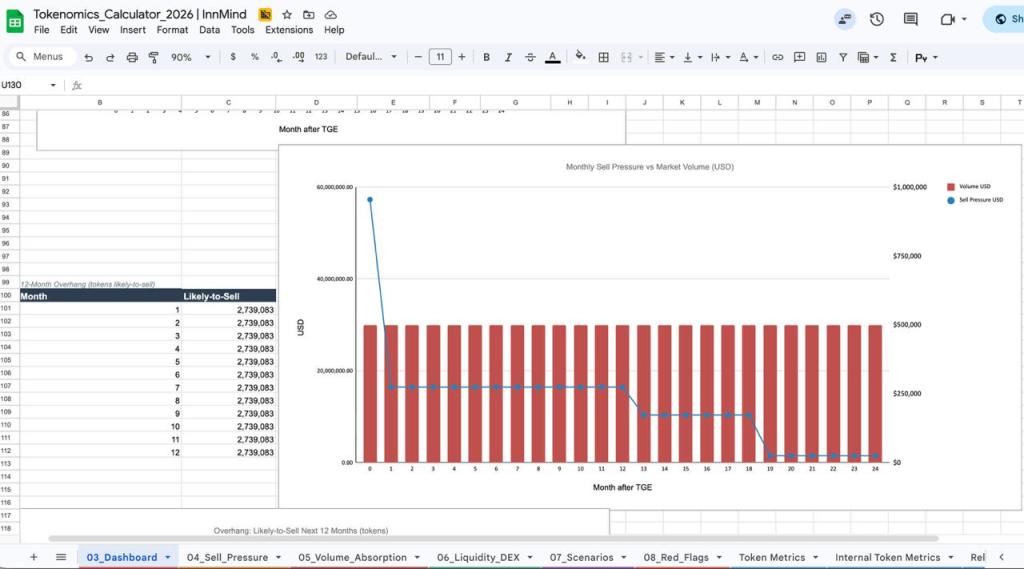
- Visualize selling pressure by stakeholder and month
- Prep investor-friendly outputs for DD, get ready-to-use tokenomics dashboards and charts for your data room and pitch deck
Battle-tested over multiple market cycles. Built for founder workflows, not academic tokenomics.
What’s inside this Tokenomics Calculator Template Spreadsheet
This is not a “single calculator tab”. It’s a full tokenomics workbook with linked modules, dashboards, and checks. You edit inputs once and the model updates outputs across the file.
Core modules (the ones you will actually use)
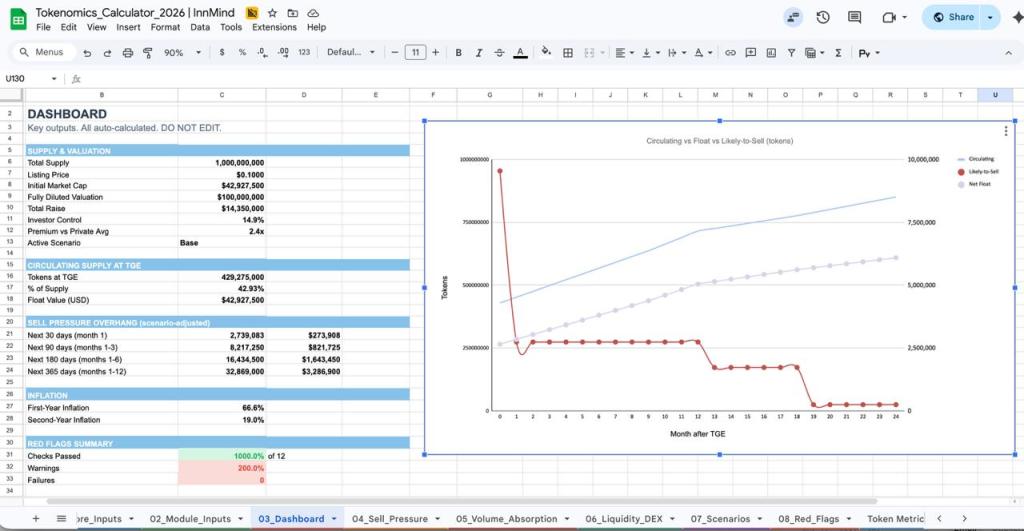
- Dashboard (one-slide overview)
Key launch metrics, scenarios, and deck-ready outputs in one place. - Summary
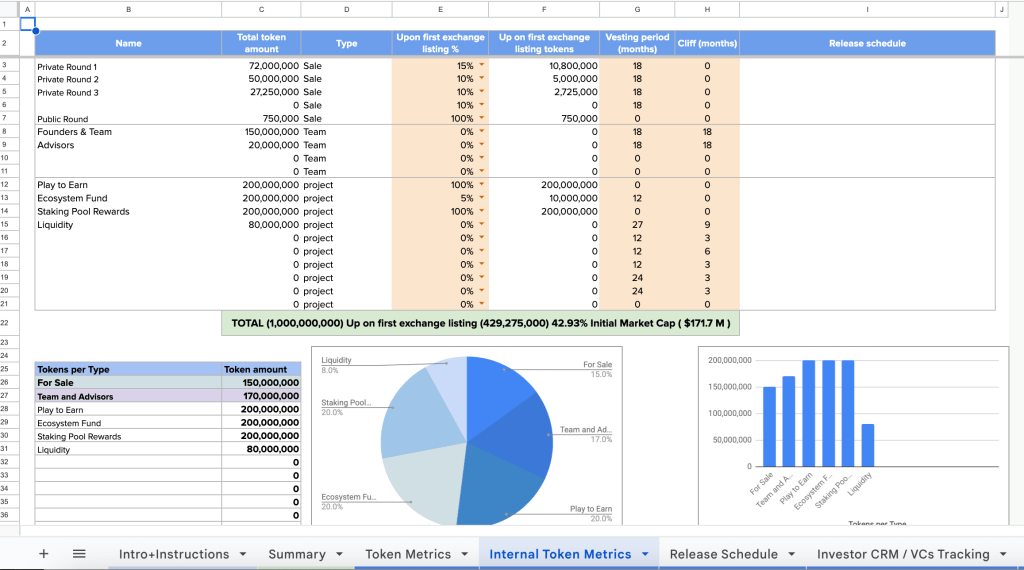
Clean recap of assumptions and results for quick reviews. - Release Schedule (vesting, cliffs, unlocks)
Build the unlock calendar and see circulating supply evolve over time. - Internal Token Metrics
Consolidated token parameters, allocations, and sanity checks. - Sell Pressure
Model unlocked supply, net float dynamics, and likely-to-sell behavior over time. - Volume Absorption
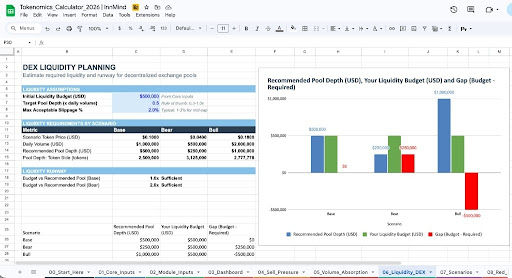
Reality-check sell pressure against market volume assumptions. - Liquidity Planning (DEX)
Estimate liquidity needs at launch and validate feasibility under different assumptions. - Market Scenarios (Base / Bear / Bull)
Stress-test outcomes by adjusting price, volume, liquidity, and release parameters.


Bonus tabs (optional, but useful)
- Red Flags (investor-style checks)
A quick checklist to catch common tokenomics risks before you get questioned on calls. - Advisory Allocations + Advisory Structure
Practical helper tabs for advisory terms and allocation structure. - Benchmarks
Reference comparisons and quick sanity checks when you need context. - Lightweight Investor CRM
Optional tab for tracking fundraising conversations and follow-ups.
How it works: change inputs (allocations, vesting, price, volume, liquidity assumptions) and the workbook updates dashboards, charts, and checks automatically.
Who is this for?
This template is for you if you are:
- Pre-TGE and need a clean model for VCs, launchpads, exchanges
- Post-TGE and trying to understand how future unlocks hit price and liquidity
- Designing a community sale / public round and want to avoid supply shock optics
- Negotiating vesting terms and need to show tradeoffs in numbers
Not ideal if: you want a theoretical tokenomics paper or a custom consulting deliverable. This is a practical spreadsheet for decisions.
What you receive:
What you receive
- Your own editable Google Sheets copy with 12+ practical tabs, built-in formulas and visual charts (and 3 bonus tabs for fundraising, captable tracking & competitors tracking)
- Auto-generated graphs, linked charts and dashboards (ready to paste into pitch deck slides)
- In-file instructions and inputs map
- Instant access right after checkout
Is it Google Sheets or Excel?
Google Sheets, optimized for both work in GDrive and for download on desktop. No macros, no plugins, no version conflicts.
Can I use it for any chain (EVM, Solana, etc.)?
Yes. It’s chain-agnostic. The logic is about supply, unlocks, liquidity and market scenarios.
Does it calculate vesting and unlock schedules automatically?
Yes. You set allocations and vesting rules, it generates schedules and charts.
Will this help with liquidity planning?
Yes. There is a dedicated liquidity module so you can model liquidity needs alongside unlock dynamics.
Can I share outputs with investors?
That’s the point. The file is structured to be readable in DD and easy to copy charts into a pitch deck.
After you finalize your tokenomics
Once you’ve built your token model, these related templates will help you move faster with fundraising and execution: